


Every organisation is racing to answer the same question: what will AI do to leadership? It is the wrong question. Generative AI is not a substitute for judgment, character or presence. It is a magnifying glass. It amplifies whatever a leader already brings to the table — clarity or confusion, conviction or drift, trust or its absence. The leaders who thrive will not be those who use AI the most. They will be those whose leadership is worth amplifying.
Since it's inception, we have long treated generative AI as a productivity tool. Faster drafts, cheaper analysis, compressed decision cycles. That story is real, but it is incomplete. The more consequential shift is quieter.
As AI absorbs the mechanical parts of our job (summarising, writing the first drafts, etc.), what remains is the distinctly human core of leadership. And that core is now exposed.
When routine cognitive work is automated, the questions that are left are the ones AI cannot answer for you: What are we actually trying to do? What will we not compromise on? Who is accountable when this goes wrong? Those questions were always the essence of leadership.
The Amplification Principle
Think of generative AI as a leverage. Leverage multiplies force in whichever direction it is applied. Point it at a clear strategy and disciplined culture, and you get compounding advantage. Point it at ambiguity, misaligned incentives and weak accountability, and you magnify those problems at scale.
This is why two organisations can deploy the same tools and land in opposite places. The technology is not the variable. Leadership is. AI expands what an organisation can do; it says nothing about what it should do. That determination has never belonged to a machine, and it never will.
The practical implication is uncomfortable: adopting AI will not fix a leadership gap. It will reveal the gap, and then widen it.
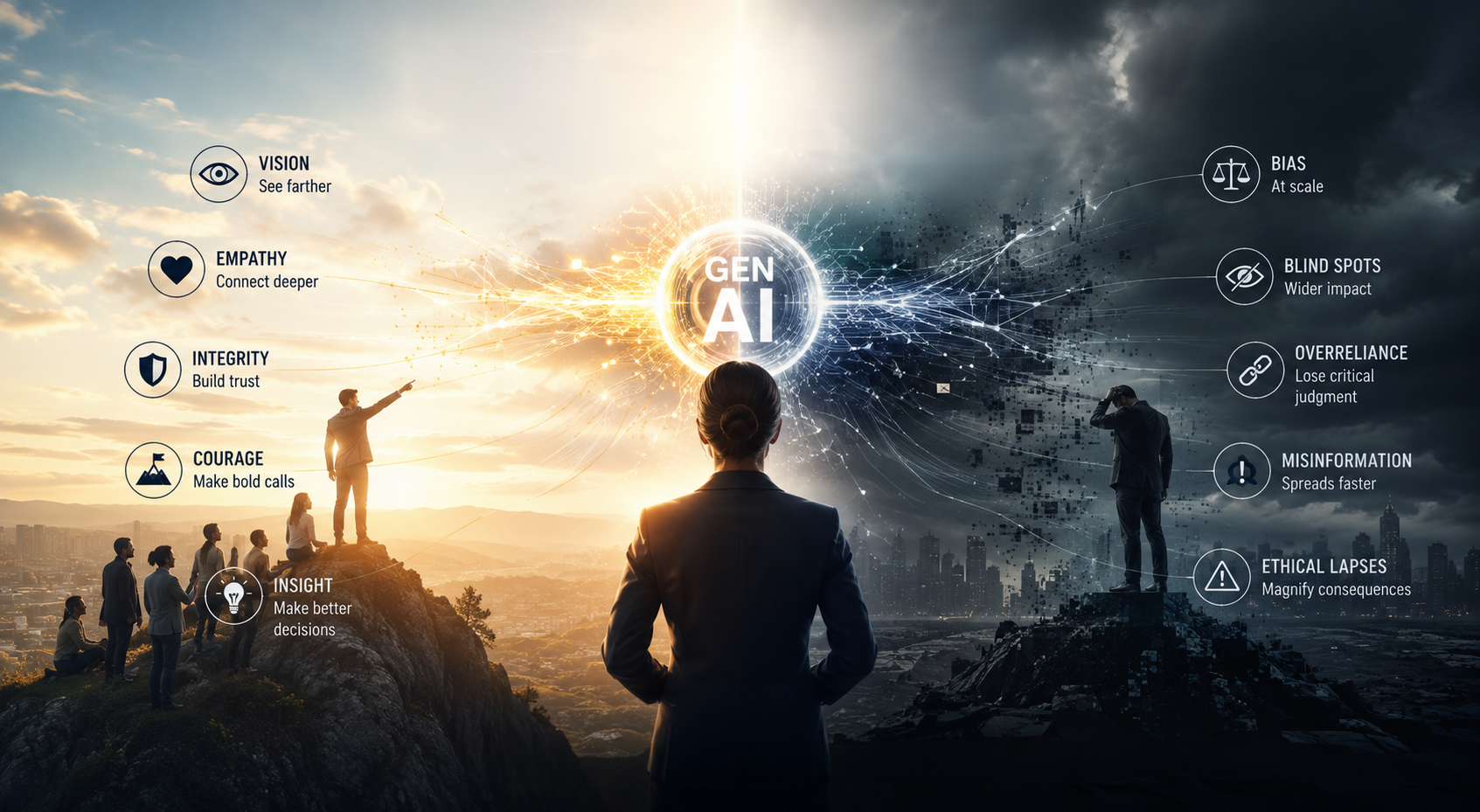
What Gen AI Amplifies (For Better or Worse)
1. Clarity of Purpose: AI is extraordinary at generating plausible options and confident answers. What it cannot do is tell you which option matters, or why. A leader with a sharp sense of purpose uses AI to explore more possibilities and move faster toward the right one.
A leader without that clarity uses AI to generate more noise, more decks and more motion mistaken for progress. The tool amplifies the direction you set, or the absence of one.
2. Judgment under Uncertainty: Generative systems are fluent, and fluency is persuasive. But a confident answer is not a correct one, and roughly half of the hard calls a leader faces involve incomplete or conflicting information.
AI can structure the trade-offs and surface the risks; it cannot weigh competing values, absorb the consequences, or decide what is right when what is profitable points the other way. Leaders who outsource judgment to a fluent machine will make faster decisions and faster mistakes.
3. Voice and Presence: There is a subtle danger in letting AI draft everything you say. Over time, a leader's communication can drift toward a smooth, generic median. Technically competent, but emotionally hollow.
People do not follow a median. They follow a voice they recognise, one that reads the room, takes a position, and stands behind it. The leaders worth following will treat AI as a thinking partner, not a ghostwriter for their conviction.
4. Trust and Connection: Leadership has always been a social process, built through communication, empathy and the accumulation of trust over time. No model can hold a difficult conversation, sense unspoken anxiety in a team, or earn the credibility that only comes from being seen to carry the weight of a hard decision.
As transactional work is automated, these relational capabilities become more valuable.
5. Accountability: AI can inform a decision, but it cannot own the consequences. When something goes wrong, a flawed recommendation, a decision no one can quite explain, the real risk is not that AI replaces leaders, the risk is when leaders hide behind it.
What This Means for How You Lead
If AI amplifies what already matters, then the leadership agenda is clear. This is where human leadership is irreplaceable. AI can optimise toward a target. Only a leader can decide whether that target is worth pursuing at all.
- Sharpen your purpose before you scale your tools. Ambiguity does not survive contact with automation; it multiplies. Decide what you are actually optimising for before you hand the levers to a machine.
- Protect your judgment. Use AI to widen your options and pressure-test your thinking. Then, own the call. Never let a fluent answer by a machine stand in for a your own judgement.
- Guard your voice. Let AI help you prepare, not perform. From reading the room, taking a stand, delivering hard news, these moments truly define a leader, and they should remain unmistakably yours.
- Reinvest the time you save into people. The hours AI gives back are the whole point. Spend them on the coaching, the trust-building and the difficult conversations that no system can conduct for you.
- Make accountability explicit. Before you deploy, decide who answers when it fails.
The Bottom Line
Generative AI is the most powerful amplifier of leadership we have ever built. It will make strong leaders faster, sharper and more far-reaching; and it will expose weak ones just as quickly. The technology is neutral; the direction is not.
Leadership was always the part machines could not do. AI has simply made that impossible to ignore.
Want to Up Your Leadership Game in the Age of AI?
Explore bespoke SMU Executive Development's suit of leadership programmes designed to equip leaders with the mindsets and toolkits to thrive in today’s AI era.
- Emerging Asian Leaders Programme
Get practical wisdom of regional company leaders in an experiential journey that integrates learning, reflection, and real-world application. You will learn to leverage technology thoughtfully, amplifying what truly matters, and develop the mindset, skill set, and network needed to lead with clarity and purpose in an increasingly complex, fast-changing world. - EXCEL Leadership Programme
Designed for middle-to-senior high performing managers, the programme helps you to address your leadership blind spots. Through a 360 psychometric assessment and business simulations, the emphasis throughout is on application, to help you become a better and more effective leader in the context in which you work now whilst building skills for the future. - The Steward Leadership Advantage
Drive values and sustainable business growth for your orgnisation's stakeholders, as well as for the society and the environment in an AI-enabled future. You will learn best practices from Steward Leaders in action to "do well by doing good" by activating the Steward Leadership Compass© by the Steward Leadership Institute. - SMU-SID Directorship Programme
Taught and delivered by SMU's leading faculty and Singapore Institute of Directors' strong network of industry professionals, the programme offers deep insights into your legal obligations as a director. Closely aligned with the SID Director Competency Model, the programme will enhances your boardroom skills and update your knowledge and capabilities to navigate an increasingly complex business environment.