


In an era where complexity outpaces certainty, the leaders who win are not the ones with the perfect plan—they are the ones who learn fastest. Design Thinking offers a structured, human-centred discipline for turning ambiguity into action, one tested idea at a time.
The Problem with the Perfect Plan
Most leaders are trained to analyse their way to a single correct answer, then defend it through execution. This worked when business environments were stable and predictable. It works far less well today, in a landscape defined by complexity, accelerating change, and customer expectations that shift faster than annual strategy cycles can accommodate.
The traditional instinct—analyse exhaustively, commit fully, then deliver—carries a growing risk: by the time you discover your plan was flawed, you have already spent the time, capital, and credibility required to find out.
There is a better way to map action plans. It begins with a different premise: that the goal is not to be right on the first attempt, but to be wrong quickly, cheaply, and intelligently—and to improve with every cycle. This is the discipline of Design Thinking.
What Design Thinking Actually Is
Design Thinking is a human-centred approach to solving complex problems. Crucially, it is both a process and a mindset—and leaders who adopt one without the other rarely capture its value.
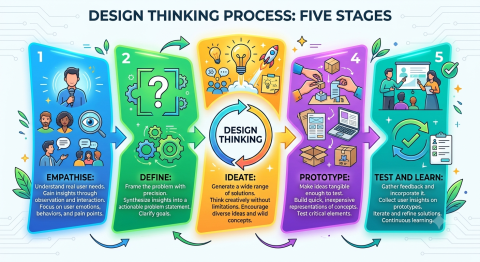
The process moves through five stages: Empathise (understand real user needs), Define (frame the problem with precision), Ideate (generate a wide range of solutions), Prototype (make ideas tangible enough to test), and Test and Learn (gather feedback and incorporate it).
The mindset rests on four habits: empathy, collaboration, experimentation, and a beginner's mind—the willingness to question assumptions you have stopped noticing.
At its core, Design Thinking is a practical, adaptable tool for solving complex problems. It empowers leaders to do three things their teams urgently need: empathise, collaborate, and iterate.
The Core Insight: Failure Is a Cost You Can Manage
The most important shift Design Thinking asks of a leader is this: stop treating failure as an event to be avoided, and start treating it as information to be acquired—as early and as cheaply as possible.
Prototyping, testing, and learning is an iterative process of repeated cycles: you build a prototype, test it, learn from the results, and refine. Each loop surfaces issues while they are still small, inexpensive, and easy to correct.
The economics are decisive. Risk drops as iterations increase, while the cost of failure rises the longer a project runs. A flaw found in a rough sketch costs almost nothing to fix. The same flaw found after launch can cost a market position. This produces a powerful operating principle:
It is better to "fail fast" and iterate quickly than to wait until you think you have the right answer and "fail late."
To begin, you need only a starting point—even one you know to be imperfect. That "wrong" first prototype is not a weakness in the process. It is the engine of it.
Three Questions That Sharpen Every Decision
Generating ideas is easy. Choosing the right ones is where leadership is tested. Design Thinking offers a durable filter—the intersection of three lenses:
- Desirability — Do people actually want this? (The human lens.)
- Feasibility — Can we realistically build and deliver it? (The technical lens.)
- Viability — Does it make sustainable business sense? (The commercial lens.)
Innovation begins where desirability lives, but it only endures where all three overlap. Mapping initiatives against these questions converts a long list of attractive ideas into a short list of defensible decisions.
What This Looks Like in Practice

Airbnb was nearly bankrupt in 2009, earning $200 a week as growth stalled. Instead of diagnosing the problem from behind a dashboard, the founders flew to New York to meet hosts, and found the real barrier—dark, amateur photos that gave guests no real sense of a space.
Their fix was deliberately un-scalable: they rented a camera and shot professional photos themselves. Bookings climbed. Permission to experiment with non-scalable changes is what pulled them out of the red, and that culture of small, testable bets became central to building a billion-dollar business.

DBS Bank in Singapore offers a closer-to-home example. In 2009 it was a slow that the joke was that DBS stood for "Damn Bloody Slow", referring to the long queues, sluggish card processing, and the worst customer-satisfaction scores of any Singapore bank.
A decade later it had been crowned the world's best bank. The turnaround was driven by human-centred design and a single mission, to "make banking joyful", mapping real customer journeys and testing ideas against one simple rubric: if it made sense for the customer, it was worth trying.
The pattern is identical. Leaders did not start with the answer.
They started with the user, framed the right question, built something testable, and let evidence guide refinement.
From Insight to Action
A few practical moves bring the discipline into how teams set direction:
- Reframe problems as "How Might We" questions to open solution space a rigid problem statement would close.
- Diverge before you converge. Brainstorm for quantity first; then apply the desirability–feasibility–viability filter to narrow with discipline.
- Prototype at the lowest useful fidelity—a process map, storyboard, or rough mock-up is enough to learn quickly and fail cheap.
- Build a tight feedback loop: What works well? What could improve? What would make this more practical? Then iterate.
- Model the mindset. Teams experiment only when they see leaders make it safe to do so.
The Leader's Real Role
For a leader, Design Thinking is more than a workshop technique. It is a reliable method for moving forward under uncertainty without pretending it away. It replaces the false comfort of the perfect plan with the genuine confidence of tested evidence.

It reduces the risk and cost of failure by addressing issues early—and it empowers leaders to empathise, collaborate, and iterate toward solutions that actually work.
Find out more about SMU Executive Development's Team Lead Programme for on Agility & Effective Management that helps new leaders and team lead to map action plans for self and team with design thinking.