


For years, cybersecurity strategy has been guided by a comforting assumption: that with the right tools, the right architecture, and sufficient investment, organisations can prevent attacks. That assumption no longer holds.
In an era defined by Advanced Persistent Threats (APTs), cyber risk is not episodic. It is continuous, adaptive, and often strategically orchestrated. Attackers are no longer opportunistic; they are patient, well-resourced, and capable of exploiting not only technical vulnerabilities, but organisational blind spots.
The question is no longer whether an organisation will be breached, but how it will withstand, respond, and evolve when it is.
This is why the strategic conversation is shifting from cybersecurity to cyber resilience.
Resilience Is Not a Technical Capability. It Is a Leadership Capability
Cyber resilience is often described through four essential capabilities: the ability to anticipate, withstand, respond, and adapt to cyber threats. These capabilities are supported by enabling organisational elements such as governance, culture, ecosystem coordination, and strategic alignment.
Most organisations today are investing heavily in strengthening these components. Yet, when major incidents occur, failures rarely stem from a lack of tools or frameworks. They stem from something far less visible: a breakdown in leadership integration.
During a cyber crisis, multiple realities collide:
- Technical teams operate under uncertainty, still trying to understand the nature of the attack
- Executives must make decisions with incomplete information and significant business implications
- Regulators demand clarity and speed
- Customers and the public expect transparency
- Boards focus on risk exposure and reputational impact
This is why cyber resilience is fundamentally a leadership challenge. It requires bringing together diverse parts of the organisation — cybersecurity specialists, risk and legal teams, communications, business unit leaders, and the board — and ensure they operate with shared priorities during periods of uncertainty.
It is a different kind of leadership that can translate cyber risk into business impact, guide board-level decision-making, establish clear escalation structures, and maintain alignment between operational response and regulatory obligations for business continuity.”
— Francois Bogacz, Head of Learning and Innovation, SMU Executive Development, Co-Programme Director, Cybersecurity Strategic Leadership Programme

What determines the outcome is not the sophistication of the technology alone, but the organisation’s ability to align decisions, actions, and priorities across these competing pressures in real time.
This is where traditional leadership models often falter.
Why APTs Challenge Traditional Leadership Models
Most leadership development, even at senior levels, is still designed around relatively stable operating conditions—where problems are bounded, stakeholders are clearly identified, and cause-and-effect relationships can be reasonably mapped.
Leaders are given the luxury of time to analyse, deliberate, and arrive at informed decisions in such environments, and this creates a model of leadership that privileges structured thinking and linear problem-solving, often assuming that clarity precedes action.
Advanced Persistent Threats (APTs), however, fundamentally upend these assumptions. They operate in conditions where ambiguity is constant, attribution is elusive, and consequences spill across technical, legal, geopolitical, and reputational domains simultaneously.
In these situations, leaders are forced to act before full clarity emerges, making judgement under uncertainty not the exception but the norm. The implication is stark: leadership capability can no longer be defined by the ability to analyse well-formed problems, but by the capacity to navigate incomplete information, balance competing risks, and make timely decisions in environments that resist neat resolution.
For such contexts, leadership cannot rely solely on expertise, authority, or linear problem-solving. They need to navigate and adapt to complex challenges, which require the ability to operate simultaneously across multiple dimensions of complexity.
The Missing Link: The Mastery of Three Spaces of Leadership
What distinguishes organisations that demonstrate true cyber resilience is not just what they do, but how their leaders think and act.
Effective cyber leadership requires the integration of three interconnected spaces:

1. Leading Self: Clarity Under Ambiguity
In the early stages of an incident, information is incomplete, evolving, and often contradictory. Leaders must make decisions without full certainty, manage cognitive overload and emotional pressure, and avoid the traps of premature closure or overreaction—all while the situation continues to unfold.
This is not simply a matter of experience. It reflects a leader’s underlying mindset and meaning-making capacity: how they interpret complexity, navigate uncertainty, and make sense of risk in real time.

2. Leading Others: Alignment Under Pressure
Cyber crises expose organisational fault lines, as different stakeholders optimise for different outcomes: security teams focus on containment, business leaders on continuity, legal on compliance, and communications on reputation. These priorities are valid, but in moments of crisis, they can fragment decision-making when alignment matters most.
Under these conditions, effective leadership is about creating clarity and unity under pressure. Leaders must bring these perspectives together into clear, coherent, coordinated action. This requires influence beyond authority, the ability to translate technical risks into business impact, and the trust to align teams quickly across functions and hierarchies.

3. Leading the System: Orchestrating Resilience
Cyber resilience is not built in the moment of crisis. It is built beforehand through organisational design and routines.
Leaders must ensure that governance structures enable rapid decision-making, with clearly defined roles and escalation pathways that remove ambiguity in critical moments.
At the same time, resilience cannot sit in silos—it must be embedded across functions, with a clear understanding and active management of ecosystem dependencies that could amplify risk.
This is the domain of systems leadership — the ability to see interdependencies and align them toward a shared outcome.
Bringing it Together: The Cyber Resilience-By-Routine Framework
ISTARI’s Cyber Resilience-By-Routine Framework, also known as the bow-tie model, defines what resilient organisations must do.
- Anticipate requires systems thinking and strategic foresight
- Withstand depends on organisational alignment and disciplined resource allocation
- Respond demands rapid coordination and decision-making under pressure
- Adapt requires reflection, learning, and the capacity to challenge existing assumptions
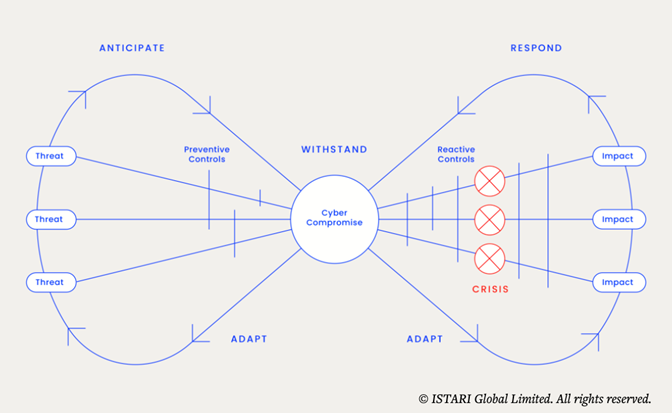
"Advanced persistent threats are sophisticated campaigns that place organisations under sustained hacking pressure. ISTARI’s bow-tie model helps leaders connect prevention before compromise with response after compromise.
That is how resilience is built by routine: not through the pursuit of perfect prevention, but through organisational preparation to anticipate, withstand, respond, and adapt.”
— Dr. Lucas Kello, Strategic Advisor, ISTARI & Associate Professor at the University of Oxford

Failure in any one leadership space creates fragility across the entire system.
An organisation may have strong detection capabilities but fail to respond effectively, or to learn and adapt. It may invest heavily in technology but lack the governance to prioritise correctly.
Cyber resilience, therefore, is not the sum of isolated capabilities. It is the product of integrated leadership across self, others, and system.
From Leadership Competencies to Leadership Maturity
As many senior leaders operate effectively in structured environments but can struggle when faced with systemic ambiguity and competing perspectives, developing this form of leadership is not simply about acquiring new skills.
It requires a shift in how leaders evolve through different stages of meaning-making. Research in adult development shows that leaders:

1. Interpret and synthesise complexity

2. Balance competing priorities

3. Make sense of uncertainty
In the context of cyber resilience, it’s critical for leaders to be able to move beyond purely technical or functional viewpoints, integrate multiple perspectives simultaneously, and operate at a level where they can reshape systems, not just manage them.
In other words, cyber resilience requires not just better leadership, but more mature leaders.
A New Archetype of Cyber Leader
In an age of persistent threats and geopolitical complexity, cyber resilience cannot be reduced to mere tools and compliance checklists. It is the outcome of leadership that can:
- remain clear under ambiguity
- align diverse stakeholders under pressure
- orchestrate systems that perform reliably in crisis
This is a fundamentally different archetype of leader: a systems-oriented, adaptive, and integrative leader capable of guiding organisations through uncertainty.
As organisations deepen their investments in cybersecurity capabilities, the real question is whether leaders have the capabilities to coordinate effectively, especially under pressure, when decisions carry the greatest consequence.
The demands of leadership in the cyber space have fundamentally shifted, requiring individuals who can bridge technical complexity with strategic judgement, and translate capability into coordinated action.
This raises a more critical lens: leaders themselves must assess themselves rigorously for their ability to navigate ambiguity, integrate systems, and respond decisively in high-stakes moments. Because ultimately, cyber resilience is not built in systems alone—it is forged through leadership that can mobilise them when it matters most.
It is built in the way leaders think, align, and act across self, others, and system.
Cybersecurity Strategic Leadership Programme: Developing Leadership for Persistent Threat Environments
Recognising this shift, Cyber Security Agency of Singapore (CSA), SMU Executive Development, and ISTARI developed the Cybersecurity Strategic Leadership Programme (CSLP), specifically designed to support the transition of technical cyber leaders to transformative business leaders.
Find our more about the Cybersecurity Strategic Leadership Programme.
The programme is not structured around cybersecurity topics alone. It is a developmental journey aligned with the realities of persistent threat environments.

Module 1: Strategic Cyber Leadership Under Persistent Threat
Participants explore how their mindset shapes their leadership effectiveness, particularly under uncertainty. They will develop the ability to lead under ambiguity, navigate power dynamics and accountability tensions, and communicate and influence at executive level.

Module 2: Global Approaches for Cyber Resilience-by-Routine
Participants will engage with global perspectives on cyber resilience and the Resilience-By-Routine framework; and they will learn to anticipate adversarial intent and systemic risk, align organisational capabilities across governance, culture, and ecosystem, as well as frame and quantify cyber risk to inform strategic decisions

Module 3: Leadership Execution Under Pressure
The programme culminates in application. Through simulations, board-level interactions, and action learning projects, participants will experience the realities of crisis decision-making, practice aligning stakeholders under pressure, and demonstrate strategic leadership in complex, real-world scenarios