

Programme Partner

Overview
Drive AI transformation with the strategic acumen, technical literacy and leadership capability
AI has moved from the periphery to the core of competitive strategy. For leaders, this shift is both an opportunity and an imperative. The organisations that will define the next decade are those that turn AI fluency into strategic advantage — reshaping business models, operations, and culture with intent.
The Singapore Management University's Chief AI Officer Programme equips you with the strategic acumen, technical literacy and leadership capability to drive AI transformation in your organisation. Designed specifically for leaders navigating AI adoption in dynamic, resource-conscious environments, the programme integrates rigorous academic frameworks with practitioner insight and applied learning — enabling you to move with confidence from strategic clarity to decisive execution.
Delivered by SMU Executive Development, the programme combines live interactive virtual sessions, intensive working labs and a two-day in-person immersion on the SMU campus. Participants will develop an AI Transformation Roadmap — a rigorous, personalised capstone deliverable designed to guide enterprise-level decision-making and organisational transformation well beyond the programme.
- Next Course Starts On 3 October 2026 (Sat)
- Duration6 Months
- LevelAdvanced
- VenueHybrid


PROGRAMME HIGHLIGHTS

2-day in-person immersion
at SMU campus, Singapore

2 industry visits (Day 1: AWS/Certis
& Day 2: Microsoft/Google)

12 live interactive virtual sessions
by SMU faculty

4 live interactive virtual sessions
by global industry experts

AI Transformation Roadmap:
3 structured working lab sessions

AI Transformation Roadmap final report
out and personalised feedback

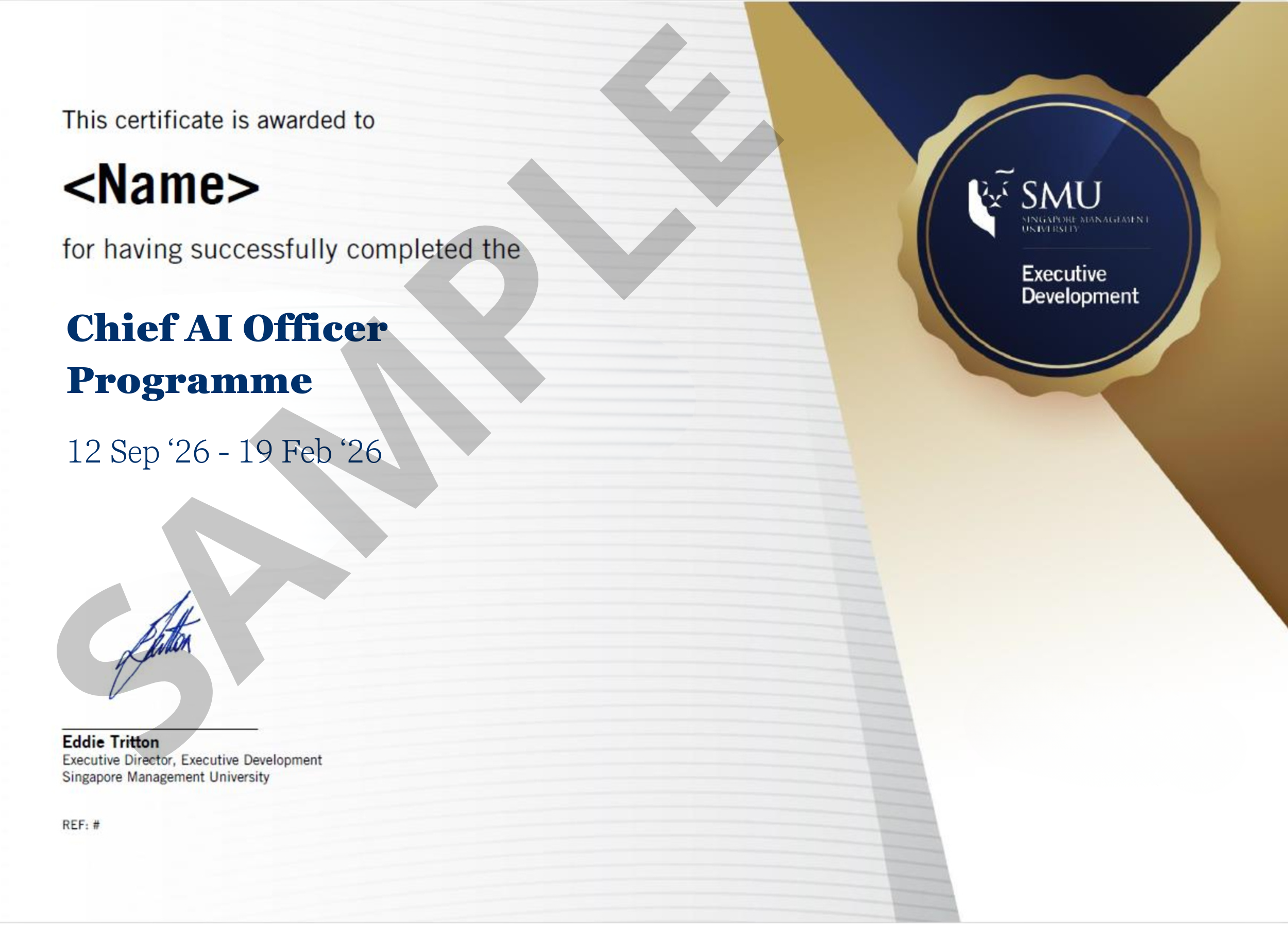
Certificate from
Singapore Management University

Associate Alumni status
upon successful completion of the programme

Peer coaching
and assessments
Topics/Structure

Day 1: AI in Action: Translating Strategy into Scalable Enterprise Solutions
- Building on the strategic foundations covered in the virtual modules, this session focuses on translating AI ambition into execution.
- Participants will explore how organisations move from pilots to enterprise-scale deployment, with emphasis on data strategy, infrastructure readiness, and human-machine collaboration.
- The session will also unpack real-world challenges in operationalising AI—balancing innovation with governance, managing risks, and ensuring alignment with business value.
- Participants will stress-test elements of their AI Transformation Roadmap, refining priorities and execution pathways.
Afternoon Site Visits
AWS/ Certis
Participants will visit AWS or Certis to explore how leading organisations operationalise AI at scale by navigating the complex intersection of cloud infrastructure, data governance, and enterprise risk with rigour and precision.
- Scaling AI: From pilots to enterprise-wide deployment
- Data strategy and AI infrastructure readiness
- Human-AI collaboration and workflow redesign
- Linking AI investments to measurable business outcomes
Day 2: Responsible AI in Action: Governance, Trust and the Human Impact of Intelligent Systems
- As organisations accelerate AI adoption, the question is no longer whether to deploy AI, but how to do so responsibly.
- This session, led by the faculty, will draw on their research at the intersection of AI, society, and digital inclusion to examine the ethical, governance, and human implications of AI at scale.
- Participants will explore how AI systems shape behaviour, decision-making, and access—often in ways that are invisible yet consequential.
- The session will unpack the governance frameworks required to ensure fairness, accountability, and trust, while also addressing the societal and organisational responsibilities of leaders deploying AI.
- Building on the programme’s earlier modules, participants will critically evaluate their AI Transformation Roadmap through a governance lens—ensuring that innovation is not only scalable, but also responsible and sustainable.
Afternoon Site Visits
Microsoft / Google
Participants will visit Microsoft or Google, engaging directly with the architects of global AI governance and the frameworks, standards, and accountability mechanisms shaping the future of responsible AI at scale.
- Responsible AI Frameworks: Fairness, transparency, accountability, and explainability
- AI & Society: Bias, digital inclusion, and unintended consequences of AI systems
- Governance in Practice: Translating principles into policies, processes, and controls
- Regulation & Trust: Navigating evolving global AI regulations and stakeholder expectations
- Human-Centred AI Leadership: Designing systems that augment rather than marginalise
Module Outcomes
- Develop the technical and strategic awareness and creativity to assess AI capabilities, anticipate disruption, and
- Make informed leadership decisions as the AI landscape continues to evolve.
The AI Technology Landscape: From Generative to Agentic AI
- Understand the evolution of AI from machine learning through generative, agentic and reasoning AI, and assess the capability trajectory that will shape enterprise decisions over the coming decade
- Examine the technical architecture underlying modern AI systems to better evaluate capability, limitation and business impact
- Apply frameworks for assessing any future AI advancement and its implications for organisational strategy
AI in the Geopolitical Arena: Technology, Trade and Global Competitiveness
- Examine the intersection of AI, trade policy and geopolitical competition in the Indo-Pacific region and globally, and assess their implications for organisational strategy
- Evaluate how technology nationalism, supply chain realignment and regulatory divergence are reshaping the landscape for AI investment and partnership
- Develop a geopolitical lens for interpreting AI-related policy developments and their near-term commercial consequences
AI Strategy and Competitive Positioning
- Develop a robust AI strategy that integrates competitive intelligence, market positioning and technology investment decisions within a coherent enterprise framework
- Identify chokepoints, leverage points and sources of sustainable advantage in AI-shaped competitive landscapes, drawing on global value chain analysis
- Translate strategic analysis into clear investment priorities, capability commitments and measurable competitive outcomes
Creative Thinking in an AI-First World
- Challenge conventional assumptions to unlock breakthrough opportunities by linking creative thinking with disruptive innovation across the “who,” “what,” and “how” of value creation.
- Activate individual and team creativity to drive bold experimentation and scalable innovation.
AI-Enabled Business Models and Value Creation
- Identify pathways for creating new sources of value through AI-enabled products, services and business model innovation
- Translate AI capability into differentiated customer outcomes and sustainable commercial advantage
Module Outcomes
- Design and lead AI-enabled transformation across workforce and sustainability dimensions,
- Translating strategic insight into executable, responsible and commercially grounded enterprise change.
Human-Machine Collaboration: Redesigning Work, Workflows and Organisations
- Examine how human-AI hybrid systems can be designed to enhance decision quality, organisational capability and operational resilience
- Redesign workflows, roles and accountability structures to maximise the complementary value of human judgment and machine intelligence
- Address the cognitive, behavioural and cultural dimensions of effective human-machine collaboration at the enterprise level
AI and Sustainable Business Value
- Align AI strategy and governance with long-term business and societal value creation
- Evaluate how AI can respond to evolving regulatory expectations
- Design AI initiatives that create durable value for business and stakeholders while managing sustainability risks
AI, Society and the Future of Work
- Evaluate the social and workforce implications of AI adoption, including job redesign, reskilling imperatives and digital inclusion, and develop strategies to lead these transitions
- Build organisational approaches for managing the human dimensions of AI-driven transformation with responsibility and care
- Examine how technology and society co-evolve, and the leadership obligations this creates for enterprise AI adoption
AI Adoption and Digital Transformation
- Apply structured frameworks to assess digital maturity and prioritise transformation initiatives according to strategic value and organisational readiness
- Design a pragmatic AI adoption roadmap that builds capability sustainably without disrupting core operations
AI Innovation to Execution
- Navigate the critical path from AI ideation to scalable implementation within the resource-conscious organisations
- Apply experimentation and validation frameworks to reduce risk while accelerating AI-driven innovation and learning velocity
- Build the organisational conditions and leadership disciplines that sustain execution without inhibiting creative ambition
Module Outcomes
- Translate AI ambition into sustained enterprise value by scaling initiatives from pilots to enterprise deployment,
- Atrengthening data and infrastructure foundations,
- Wmbedding responsible governance, and
- Leading organisational change with resilience, clarity, and influence.
Scaling AI: From Pilots to Enterprise-Wide Deployment
- Apply frameworks for scaling AI across functions, processes and decision contexts, moving from isolated pilots to repeatable, enterprise-wide value creation
- Address the governance and operational challenges that emerge as AI initiatives transition from experimentation to full-scale deployment
- Sequence scaling initiatives to balance learning velocity, risk management and organisational readiness
Responsible AI: Ethics, Governance and Trust
- Apply ethical and governance frameworks to evaluate AI use cases across the dimensions of fairness, transparency, accountability and societal impact
- Navigate the evolving regulatory landscape and shifting stakeholder expectations that shape enterprise AI adoption in Singapore and beyond
- Build organisational practices that embed trust, digital literacy and responsible innovation into AI strategy and decision-making
AI Infrastructure, Smart Systems and Data Strategy
- Evaluate the infrastructure, data governance requirements for deploying AI reliably and responsibly at scale
- Design data strategies that ensure quality, accessibility and appropriate governance as the foundational layer enabling AI value creation
The AI-Ready Leader: Narrative and Influence
- Develop compelling, credible narratives around AI strategy, risk and opportunity that resonate with diverse senior stakeholder audiences
- Build personal leadership presence and communication authority in contexts of AI-driven complexity and organisational change
- Craft influence strategies that mobilise organisational commitment, sustain strategic alignment and convert AI ambition into collective action
Building Resilience in an AI-Disrupted World
- Lead with clarity and steadiness through sustained ambiguity and accelerated technological change
- Strengthen cognitive and emotional agility to enable sound judgment for self and teams under pressure
- Build team environments that sustain performance, cohesion, and adaptability in AI-driven contexts
Leading AI-Driven Change: Organisational Readiness and Transformation
- Exercise leadership judgment in mobilising stakeholders, managing resistance and sustaining momentum throughout AI-driven organisational transformation
- Design change management approaches that address the cultural, structural and human dynamics of AI adoption in ways that build rather than erode trust
- Build organisational readiness, psychological safety and adaptive capacity to support continuous and iterative AI-driven change
Who Should Attend
This programme is designed for senior leaders and executives who are responsible for, or preparing to lead, AI-driven strategy and transformation within their organisations.
Senior leaders, founders and C-suite executives seeking to lead AI transformation with strategic clarity and executive confidence
Functional leaders and managers responsible for innovation, digital transformation or technology strategy
High-potential executives preparing to step into AI-related strategic or C-suite leadership roles
Prerequisites: Minimum 10 years of professional experience with a demonstrated track record of leadership responsibility
At least an undergraduate degree or equivalent professional qualification
Assessment
Schedule
Start Date(s) : Sat, 10/03/2026 - 12:00
Intake Information :
Upon completion of the programme, post university’s approval, you will be eligible to be part of the SMU community as an associate alumni and continue your lifelong affiliation with the university. You’d also be able to gain access to the curated benefits and perks, including exclusive resources and offers that are accorded only to SMU alumni.
- Up to 20% discount* on SMU Executive Development Open Enrolment programmes (*For selected programmes only. One discount applicable per registration. Multiple or combined discounts are not accepted)
- Invites to professional networking events, workshops and webinars
- Privileges and discounts by selected SMU merchant partners
- Quarterly alumni newsletter, SMU CIRCLE
For more enquiries, please email to smu.chiefaiofficer@xedinstitute.org.
Alternatively, you may also write to us at exd@smu.edu.sg for any urgent matters related to the programme.
COURSE FEE
US$ 5,400