

Programme Partner

Overview
The SMU Product Management with AI Programme is an 18-week programme designed to build product capabilities to evaluate, design and lead the development of AI-powered products.
It equips product professionals to apply Generative AI, Agentic AI and Multimodal AI across the product lifecycle, from opportunity discovery and strategy to prototyping, go-to-market, optimisation and scaling. Through hands-on learning, AI-powered tools, agentic workflows and AI-native PRDs, participants learn to turn AI opportunities into commercially viable products.
The programme covers the business and governance dimensions of AI, including AI economics, ROI, P&L, product metrics, infrastructure costs, responsible AI, security and privacy. Industry expert masterclasses offer practical perspectives, while an end-to-end Capstone Project enables participants to conceptualise, design and prototype a responsible AI-first product for a real-world opportunity.
- Next Course Starts On 22 December 2026 (Tue)
- Duration18 weeks, 4-6 hours per week
- VenueOnline



Learning Objectives
• Assess the suitability and limitations of AI technologies including Generative AI, multimodal AI, and Agentic AI for different product contexts
• Identify and prioritise AI product opportunities based on customer needs, business value, feasibility, and data readiness
• Develop business cases and roadmaps for AI products by considering costs, returns, unit economics, and key trade-offs
• Design and prototype AI-first products, features, and agentic workflows using appropriate product, UX, data, and human-oversight principles
• Plan the development, launch, and scaling of AI products using agile, experimentation, go-to-market, and stakeholder-management practices
• Measure and improve AI product performance using relevant product, model, and agent metrics
• Apply responsible AI and governance principles to address bias, privacy, security, compliance, accountability, and user trust
PROGRAMME HIGHLIGHTS

AI-First Product Management
Learn Gen AI, Agentic AI, Multimodal AI and AI-native product development.

End-to-End AI Product Lifecycle
Go from opportunity discovery to strategy, prototyping, GTM and scaling.

15+ AI Product Tools in Action
Hands-on learning with AI tools, agentic workflows and AI-native PRDs through demonstrations and examples.

Live Online Sessions
4+ live sessions by faculty and industry expert to gain insights on emerging AI tech, product innovation & more

Real-World AI Product Capstone
Build an AI-first product addressing a real-world opportunity.

Smarter AI Business Decision-Making
Apply AI economics, ROI, P&L, CAC, LTV, GMV and infrastructure costs.

Responsible AI Product Building
Build responsibly with AI governance, security and privacy.

SMU Associate Alumni Status & Benefits
Access SMU Associate Alumni Status & peer networking opportunities.
Topics/Structure

- Evolution of product management: traditional PM to AI-first and agentic PM
- The AI-first PM mindset: intelligence-driven and agent-driven products versus feature factories
- Core skills for the modern PM: technical fluency across ML and agentic systems, business acumen and ethical judgement
- Business-case fundamentals: ROI, payback period, cost–benefit analysis and AI/agent infrastructure costs
- Anatomy of digital products: e-commerce, marketplaces, platforms, SaaS and consumer apps
- Impact of AI and automation on PM responsibilities, tools and team dynamics
- Supervised, unsupervised and reinforcement learning: what PMs need to know
- Recommendation systems, AI search ranking and personalisation engines for digital products
- LLMs and agentic systems: reasoning, planning and tool use
- RAG, fine-tuning, prompt engineering and agentic tool use: when to use each
- Multimodal AI: image, video and voice applications in e-commerce and digital experiences
- Data science and ML collaboration: model lifecycle, evaluation metrics and bias awareness
- Agentic AI: from copilots to autonomous, goal-directed systems
- Anatomy of an AI agent: planning, memory, tool use and reasoning loops
- Autonomous product workflows: guardrails, escalation paths and success metrics
- Multi-agent systems and orchestration in digital product experiences
- Autonomy levels: copilots, semi-autonomous and fully autonomous systems
- Customer research methods: ethnography, interviews, surveys and session recordings
- Jobs-to-be-done framework for digital and AI product discovery
- AI-powered and agentic customer research: sentiment analysis, review mining and behavioural analytics
- Market sizing for digital and AI products: TAM, SAM and SOM
- Competitive intelligence using AI research agents: automated benchmarking and desk research
- Customer segmentation and AI-assisted persona building
- Product opportunity gaps and the problem–find–solve approach
- Ideation frameworks: design thinking, How Might We and AI-assisted ideation
- AI-assisted product concepts: the need–form–technology nexus
- Scoping AI and digital product opportunities: feasibility, viability and desirability
- Minimum Viable Product development
- P&L interpretation for product managers
- Unit economics for digital and AI products: CAC, LTV, GMV, margins and cost per agent task
- Product portfolio strategy and lifecycle management for digital and AI products
- Positioning digital and AI products: competitive differentiation, category creation and uniqueness
- AI-enabled market and competitive intelligence for product strategy
- AI-assisted roadmapping with agentic planning copilots
- Prioritisation frameworks: RICE, MoSCoW and opportunity scoring with AI
- AI product opportunity prioritisation: value, feasibility, data readiness, risk and strategic alignment
- AI product monetisation and business models: freemium, subscription, usage-based and outcome-based agent pricing
- Dynamic and AI-driven pricing for e-commerce and digital platforms
- Conversational and action-based agent UX patterns
- Product-vision communication with UX design teams using agentic AI design tools
- Product-vision development through real-time user feedback
- Prototyping with Figma for digital and agentic product flows
- Instrumentation fundamentals: event tracking, funnels and session data for digital products
- SQL for product managers and natural-language and agentic querying
- North Star metrics, KPIs and AI and agent performance metrics: accuracy, latency and task-success rate
- AI and agent readiness: data infrastructure, quality and governance prerequisites
- Data-informed product dashboards
- Lean and agile product development for AI and agentic feature delivery
- Agile Scrum philosophy and methodology for AI and digital product teams
- Cross-functional collaboration: engineering, data science, design, legal and finance
- Agentic systems in agile workflows: planning, quality assurance and delivery
- Risk, accountability and control in agent-assisted product execution
- Go-to-market strategy for AI-powered and agentic digital products
- Product-led growth principles and AI- and agent-driven acquisition loops
- Market understanding: AI opportunity sizing and competitive benchmarking at launch
- Launch metrics, success criteria and post-launch iteration planning
- Case study: go-to-market strategies for AI-first and agentic digital products in Southeast Asia
- AI product performance measurement through product, model and agent metrics
- AI feature evaluation across accuracy, quality, latency, cost and task success
- AI feature monitoring and performance diagnosis
- AI-specific failure modes and uncertainties
- User feedback, experimentation and online evaluation
- AI feature optimisation: behaviour, guardrails and fallback experiences
- Product decisions based on performance evidence and trade-offs
- Rapid prototyping using LLM APIs, no-code AI builders and agent frameworks
- AI workflow design and multi-step orchestration
- API, retrieval, tool and enterprise-system integration
- MVP strategy for AI features: building the smallest useful intelligence
- User validation of AI features and pre-production iteration
- Personalisation using user context, embeddings and behavioural signals
- Recommendation and ranking systems for engagement and discovery
- Continuous learning using feedback loops
- Experimentation for AI features: A/B testing, contextual bandits and online evaluation
- GenAI and agentic personalisation: conversational recommendations and next-bestaction experiences
- Business-impact measurement: engagement, conversion, retention, LTV and task success
- Translation of selected product ideas into AI features and product-level specifications
- AI product requirements across the model, data and context, user and product-system components
- AI-native PRDs as a method for formalising product requirements and dependencies
- Product-manager-led prototyping for testing product assumptions, feasibility and user value
- Iterative validation and refinement of AI features before production
- AI-specific failure modes and uncertainties in product development
- Product-requirement and design refinement based on prototyping insights
- Algorithmic bias and fairness in recommendation, search and pricing systems
- Dark patterns and consumer protection in AI-driven digital products
- Data privacy and regulatory compliance
- AI and agent security: adversarial attacks, prompt injection and tool-misuse risks
- Transparency, explainability and user consent in AI and agentic features
- Case studies involving organisations such as Amazon, the FTC and the SEC
- Platform examples including Microsoft Copilot and ChatGPT
- Strategic thinking and business acumen for senior PM influence
- AI and agentic capabilities translated into business value and executive communication
- Stakeholder management: alignment across engineering, design, legal, finance and leadership
- Product operations: tools, processes and rituals for high-performing AI and digital product teams
- AI-first and agentic-first product-team development and mentoring
- Product-impact measurement and communication: revenue, retention and adoption
- Platform thinking: scaling digital and AI products and building ecosystem value
- Multi-agent ecosystems and platform-scale orchestration systems
- Self-improving product systems powered by autonomous feedback loops
- Innovation frameworks for continuous product evolution
- Market understanding: the evolving competitive landscape for AI-first digital products
- Agent-native product organisations and operating models
- End-to-end agentic product-system design and prototyping from discovery to deployment
- Product discovery, strategy, design, development, validation and governance integration
- Product concept, feature specifications, prototype and implementation-roadmap presentation
Who Should Attend
The SMU Product Management with AI programme is designed for professionals looking to build AI-first product capabilities, transition into AI-led roles, or lead the development and scale of intelligent digital products.
Mid-Career Product & Digital Professionals
For professionals across product, digital, tech, and strategy roles who want to transition from traditional approaches to AI-first product development, leveraging AI to build better customer experiences.
Senior Product, Technology & AI Leaders
For experienced leaders in product, engineering, data, and innovation seeking to formalise their AI expertise, evaluate emerging technologies, and drive responsible AI adoption across their organisations.

Assessment
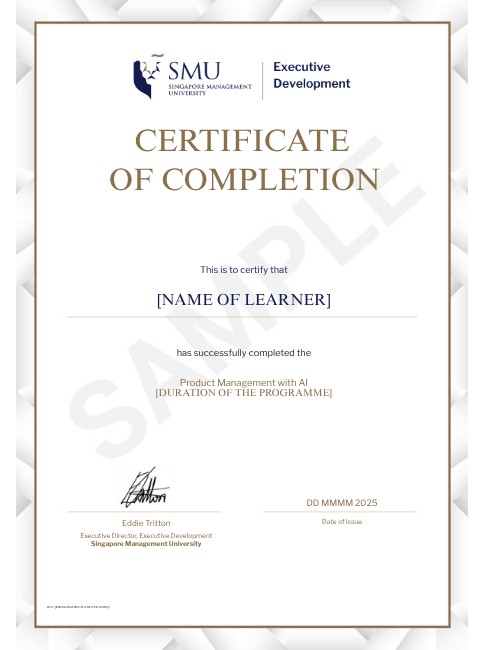
Schedule
Start Date(s) : Tue, 12/22/2026 - 12:00
Intake Information :
Refer to Online Singapore Management University Courses - Emeritus - Online Certificate Courses | Diploma Programs for the latest updates on application dates and discounts.
For more enquiries, please email to ur-opsteam-APAC@emeritus.org or ruswelt.pereira@emeritus.org.
Alternatively, you may also write to us at exd@smu.edu.sg for any urgent matters related to the programme.
Note:
- This programme is primarily self-paced online with some live sessions conducted by programme faculty. The availability of post-session video recordings is at the discretion of the faculty members, and Emeritus or the institute cannot guarantee their availability. We have a curated panel of distinguished industry practitioners who will conduct weekly live doubt-clearing sessions.
- Assignments will be graded by industry practitioners who are available to support participants in their learning journey, and/or by the Emeritus grading team. The final number of quizzes, assignments, and discussions will be confirmed closer to the start of the programme.
COURSE FEE
US$ 2,100 +Applicable Taxes
*Singapore residents who wish to enrol for this programme will be charged GST.
*Applicable taxes will be charged at checkout.