
Picture two teams presenting their results at the end of the year.
- Team A has grown sales by 18% a year for three years. New markets, new hires, big slides, lots of applause. Its leader is tipped for promotion.
- Team B has grown 4%. Same headcount. Nothing exciting to show.
Most companies will choose to reward Team A. And quite often, they are rewarding someone who may be quietly destroying value for the company.
Finance has a name for this puzzle. It's called the conundrum of growth, and it's one of the most useful ideas any non-finance leader can carry into a boardroom.
Start With a Café
Imagine you borrow $100,000 from a friend to open a café. She's generous, but not a saint. She demands $11,000 a year in return. That's her price for letting you use her money.
That 11% is called the cost of capital. It's the minimum return your shareholders expect before they'd rather deploy their money elsewhere.
The $100,000 is your invested capital, every dollar tied up in making the business work.
At the end of year one, your café makes a profit of $9,000. You tell everyone it's profitable. Technically true. But you owe your friend $11,000. You're $2,000 short. You haven't created much value. In fact, you've burned $2,000 of someone else's money while feeling successful.
The problem here? Profit ignores the full cost of equity capital. Your profit statement charges you for everything except the money tied up in the business. Salaries, rent, electricity, software. These operational costs are all deductibles. The capital sitting in your stock, equipment and unpaid invoices? All Invisible in the profit statement.
Economic Value Added (EVA) as a More Accurate Measure of True Economic Performance
Simply put, Economic Value Added (EVA) determines the true economic value created by a company by taking into account the cost of capital, invested capital and the company's operating profit.
Economic Value Added = Operating profit after tax - (Invested Capital × Cost of Capital)
For the café, $9,000 profit − $11,000 capital charge = −$2,000 EVA.
Positive EVA means you've genuinely created value. Negative means you've “destroyed” it, however healthy the profits look.
The gap between what you earn and what your money costs, i.e., 9% versus 11% is called the spread. Everything below hinges on it.
Now Watch What Growth Does
Your café earns 9% on money that costs 11%. Negative spread. You're behind by $2,000 a year.
So you grow. Another $100,000, a second café, run exactly the same way.
- Profit doubles: $18,000
- Capital charge doubles: $22,000
- EVA: −$4,000
You've doubled in size, and doubled your profit. But you're destroying value twice as fast.
Now flip the spread. If the café earned 15% against an 11% cost of capital, the first $100,000 generates +$4,000 EVA, and the second takes you to +$8,000.
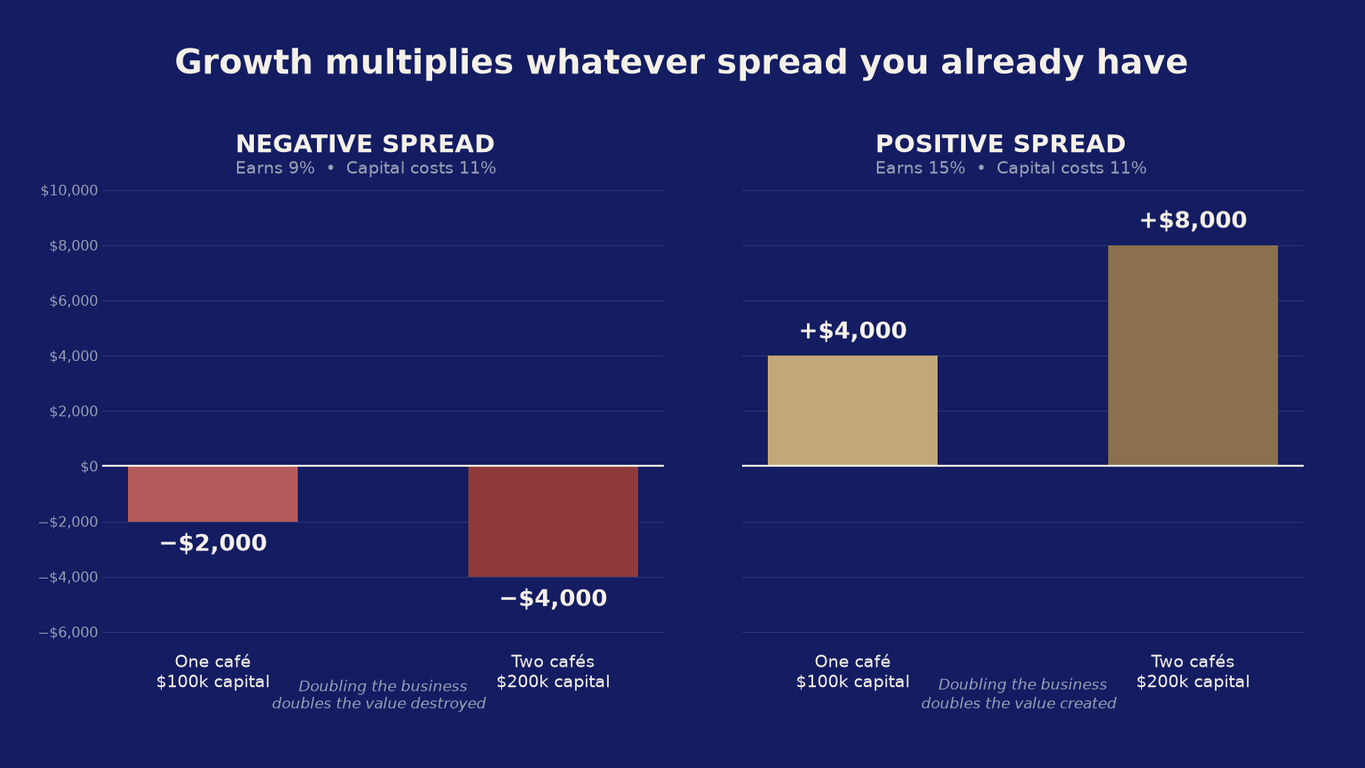
Identical growth, opposite outcome.
Growth isn't a value driver. It's a multiplier. It magnifies whatever spread you already have, positive or negative.
Sometimes, the smartest move is to stop expanding, fix the spread first. That's the hard thing to say out loud in most boardrooms, because "do less" is the least popular sentence in corporate strategy.
Prof Benedict Koh
Professor of Finance (Education);
Associate Dean (Specialised Postgraduate Professional Programmes)
SMU Lee Kong Chian School of Business

The Three Levers Businesses Can Control
EVA only moves three ways.
1. Raise returns without adding capital: Price properly, and stop discounting out of habit. Shift towards the customers and products that actually make money. Cut anything that is eating your margin.
2. Reduce the capital employed: Almost everyone ignores this one. Stock sitting in a warehouse "just in case." Customers paying 75 days late because nobody chases them. Idle machines nobody decommissioned. Three software systems doing one job. Every dollar freed up is a dollar that stops incurring a capital charge. And it usually costs nothing to fix, just attention.
This is working capital management, and it's the fastest value creation available to most functional leaders.
3. Lower the cost of capital: Volatility is expensive. Investors charge more when they're nervous. Steady earnings, reliable contracts and a spread of customers help make money cheaper.
In practical terms, here are some questions each functional leaders should ask.
- HR: Will more people lift return on capital, or just lift cost?
- Marketing: Is customer acquisition cost recovered at a rate above the cost of capital?
- Operations: How much cash is trapped in inventory? And what would releasing it be worth?
- IT: Does this platform earn its capital charge, or is it this year's largest unexamined expense?
For every business, sometimes growing bigger isn't always the goal. Profitable growth, measured against the full cost of the capital it consumes, is the one that truly matters.
Learn more in our
Finance for Leaders Programme
Next intake starts 17 February 2027
Designed to equip non-finance professionals and functional leaders with the skills to understand financial drivers, craft sound financial strategies, and safeguard organisational resources to seize opportunities that create sustainable value.
More details https://smu.sg/FFL