

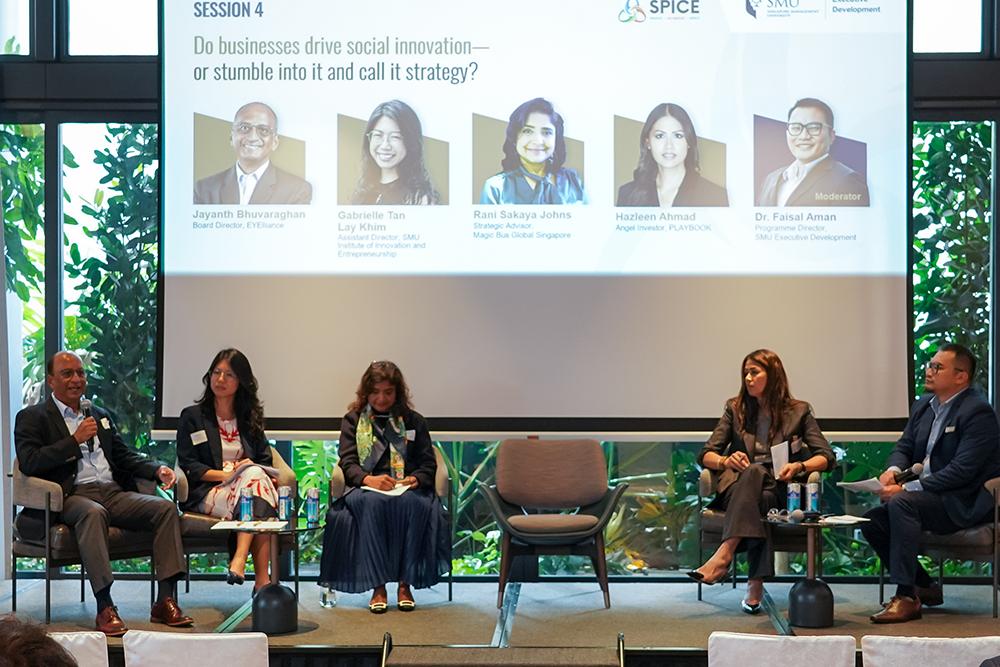
The following article is a brief recap of the discussion that transpired during the SPICE Insights Hub Conference on 26 February.
Businesses are increasingly expected to contribute meaningfully to societal challenges. Yet the path to social innovation remains unclear.
Does meaningful impact arise from deliberate strategy? Or from fortunate coincidence?
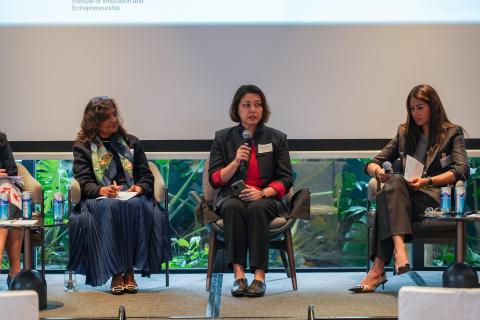
Dr Faisal Aman, Jayanth Bhuvaraghan, Gabrielle Tan Lay Khim, Sakaya Johns Rani and Hazleen Ahmad explored these questions during our SPICE panel on social innovation.
Intentionality matters
Many impactful innovations begin with personal encounters with real-world problems. Leaders who experience social challenges firsthand often develop a strong motivation to address them.
But motivation alone rarely produces scalable solutions. Effective social innovation requires:
- clear objectives
- organisational commitment
- measurable outcomes
One speaker described social innovation as a “hygiene factor”, something embedded in everyday operational practices rather than promotional campaigns.
From purpose to scalable impact


While purpose can inspire initiatives, scaling impact requires structure. Successful social innovations often rely on:
- cross-sector partnerships
- collaborative ecosystems
- supportive regulatory frameworks
- scalable organisational models
Equally important is the ability to measure outcomes.
Increasingly, organisations link social initiatives to measurable results such as employee wellbeing, workforce participation, and long-term economic resilience.


Integrating social innovation into strategy
When social innovation sits only within corporate social responsibility functions, its influence is often limited.
Embedding social initiatives into core strategy allows organisations to align societal impact with long-term competitiveness.
In this sense, social innovation may represent not a peripheral activity, but a new dimension of strategic thinking.