

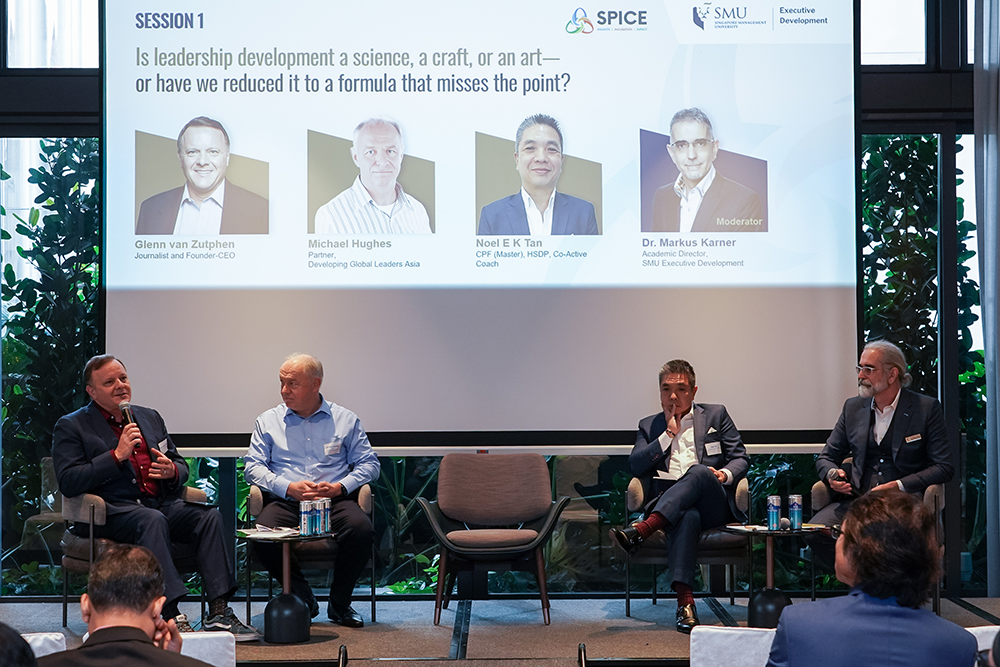
The following article is a brief recap of the discussion that transpired during the SPICE Insights Hub Conference on 26 February.
Organisations spend billions each year on leadership development programmes. Yet a persistent question remains:
How do we know whether leadership development actually works?
Unlike technical training, leadership growth rarely produces immediate or easily measurable results.
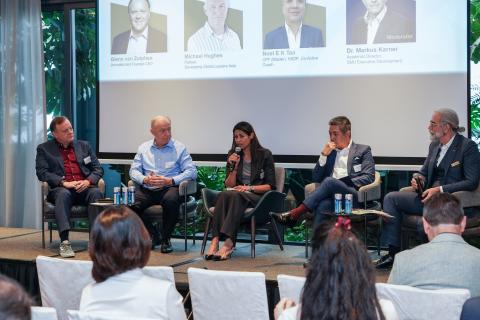
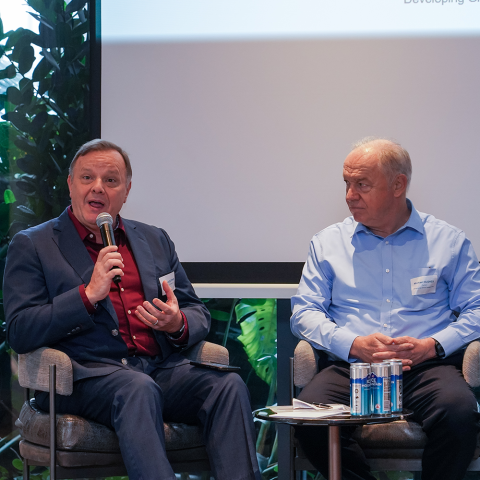
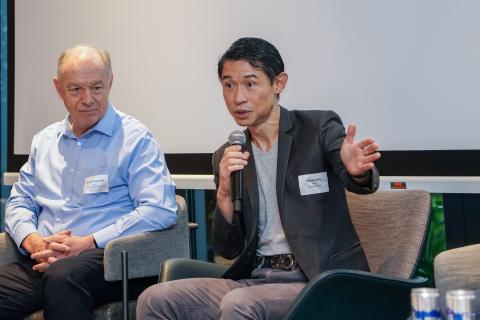
This challenge emerged during our SPICE panel discussion with Dr. Markus Karner, Glenn van Zutphen, Mike Hughes and Noel Tan, as they explore whether leadership development should be viewed as a science, a craft, or an art.
The conversation revealed two important realities about how leaders actually grow.
Leadership development unfolds slowly
Organisations often expect leadership programmes to deliver rapid and measurable improvements in performance.
In reality, meaningful development tends to emerge gradually through subtle shifts in how leaders think.
These changes often include:
- greater comfort navigating ambiguity
- stronger judgment in complex situations
- deeper self-awareness
- improved ability to integrate competing perspectives
Such developments rarely appear immediately in financial metrics.
Instead, early indicators of growth may appear in reflective practices such as journaling, leadership dialogue, and narrative reflection — tools that help leaders make sense of complex experiences.
Leadership development therefore requires time and developmental space, not simply short training interventions.
Leadership teams thrive on cognitive diversity
Another key insight from the discussion was the importance of diverse thinking styles within leadership teams.
High-performing leadership teams rarely consist of individuals who think alike.
The panel described several archetypal leadership roles frequently observed in successful organisations:
- Architects, who define long-term direction
- Builders, who translate strategy into execution
- Bridges, who connect stakeholders and perspectives
- Catalysts, who challenge assumptions and initiate change
Each role contributes a different perspective to leadership decision-making.
In this context, neurodiversity and cognitive diversity may represent significant and often overlooked leadership advantages.
Leadership development as a human journey
Leadership cannot be reduced to a simple formula.
Scientific research can inform leadership practices, and structured programmes can accelerate learning. But leadership itself remains deeply human, involving judgment, empathy, and the ability to navigate complex social systems.
Perhaps the most accurate view is that leadership development sits somewhere between science and craft: guided by evidence, strengthened through experience, and ultimately shaped by reflection.