

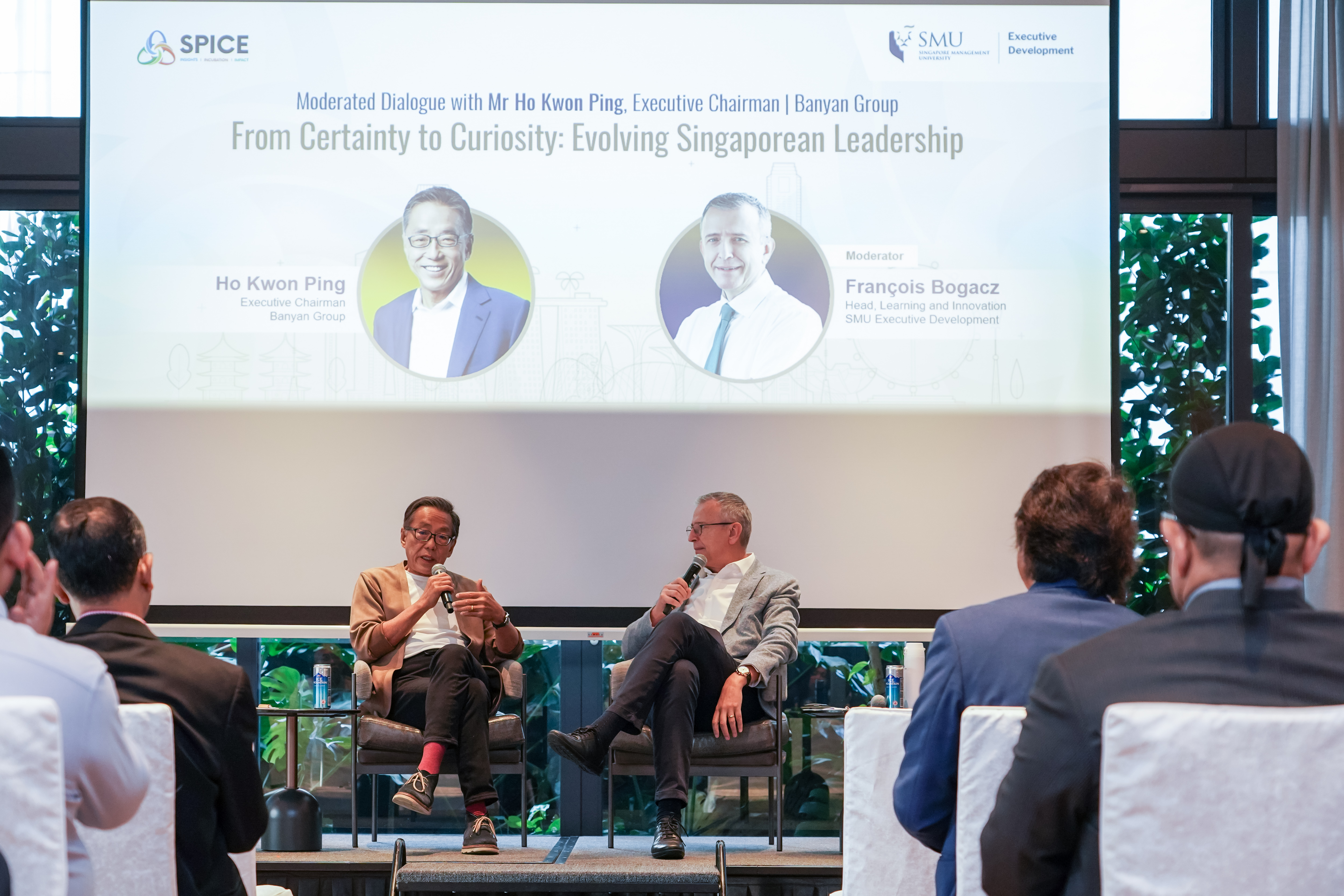
The following article is a brief recap of the discussion that transpired during the SPICE Insights Hub Conference on 26 February.
Higher education has long been organised around clear milestones: undergraduate degrees, postgraduate qualifications, and later executive programmes. Each stage represents a discrete phase in a professional’s development.
But careers today rarely follow such predictable pathways.
Industries transform rapidly, technologies reshape entire professions, and leaders must continually acquire new capabilities throughout their careers. In this environment, the traditional structure of higher education may face a deeper transformation than many institutions realise.
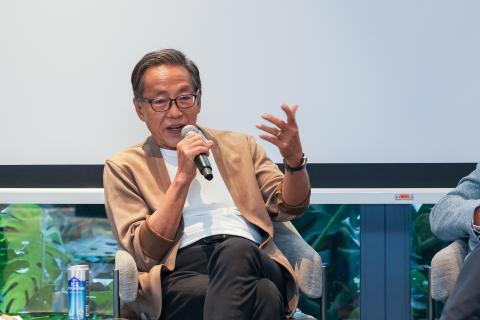
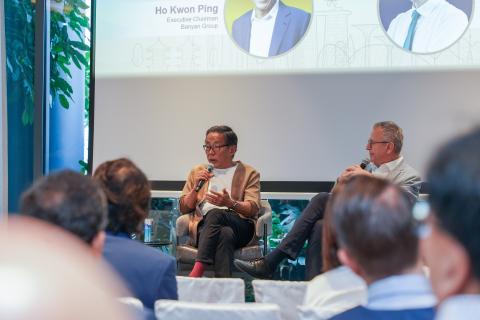
This question was explored during the opening dialogue of the SPICE Kick-off event hosted by Singapore Management University Executive Development, where Founder and Executive Chairman of Banyan Tree Holdings Ho Kwon Ping proposed a provocative thought experiment:
If universities were designed today from scratch, would they look the same?
Two emerging shifts suggest otherwise.
From programmes to lifelong learning subscriptions
Most universities still organise learning around individual programmes: degrees, certificates, or executive courses.
Yet lifelong learning may require a different model: a continuous relationship between institutions and learners across their entire careers.
Instead of enrolling in isolated programmes, professionals might maintain ongoing access to learning resources, short courses, and capability-building modules throughout their working lives.
Some observers compare this to a “subscription model” for education, where individuals or organisations maintain continuous learning partnerships with universities.
In such a system, learning pathways would be organised less around credentials and more around capabilities that evolve over time.
This shift could fundamentally reshape how universities design programmes, measure learning outcomes, and support professional development.
AI and the risk of monocultural knowledge
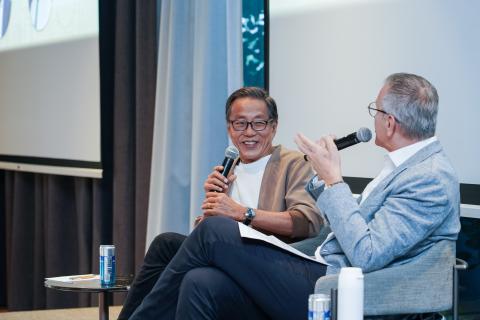
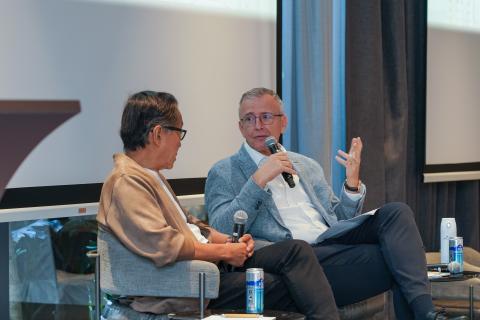
"Artificial intelligence introduces another challenges," Mr Ho said.
Many AI systems rely heavily on training data drawn from Western academic and corporate sources. While these frameworks have shaped global management thinking for decades, their dominance raises important questions for leadership development in Asia.
If AI systems reproduce existing intellectual traditions, leadership thinking itself could become increasingly monocultural.
For Asian institutions, this raises a strategic question:
Should leadership development simply import existing frameworks? Or contribute new perspectives grounded in regional values, institutions, and experiences?
In an AI-driven world, leadership may depend less on access to knowledge and more on diversifying the knowledge that shapes decision-making.
Reimagining the university of the future
Universities may therefore face a transformation that goes far beyond adopting new technologies or online delivery formats.
Instead, they may need to rethink their role in three fundamental ways:
- building lifelong relationships with learners
- developing capability-based learning pathways
- contributing diverse intellectual perspectives to global leadership thinking
The institutions that succeed will likely be those that view education not as a phase of life, but as a continuous partnership in leadership development.