

The Built Environment (BE) sector in Singapore is entering a defining phase.
Construction demand remains robust, with projections reaching S$39 billion to S$46 billion annually in the coming years. At the same time, the sector is navigating a convergence of pressures — from global uncertainty and rising costs to rapid technological disruption.
This is not just another upcycle. It is an inflection point, and one that requires leaders to rethink how the sector operates, builds capability, and positions itself for the future.
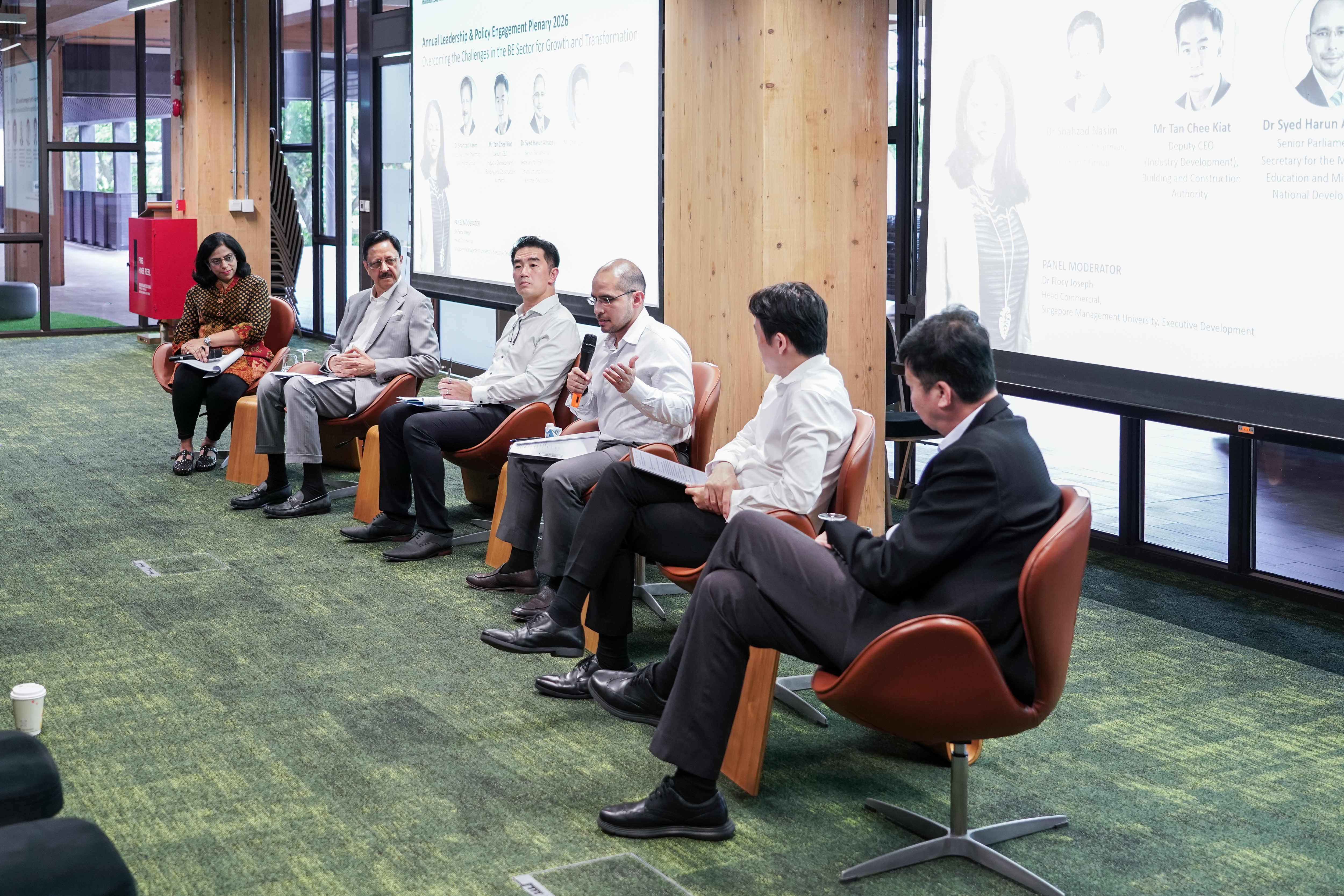
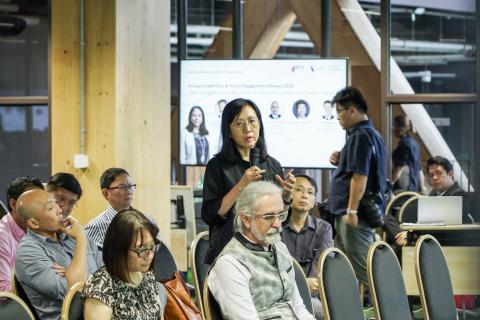
Moderated by Dr Flocy Joseph, we surfaced five critical imperatives for the road ahead at a recent leadership plenary that is part of the LEAD Horizon and LEAD Milestone Programmes with the with the Building and Construction Authority and the BCA Academy.
We brought together policymakers, regulators, and industry leaders across the Built Environment value chain:
- Dr Syed Harun Alhabsyi, Senior Parliamentary Secretary, Ministry of Education, Singapore and Ministry of National Development Singapore;
- Tan Chee Kiat, Deputy CEO, Industry Development of BCA;
- Hsing Yao Cheng, Group CEO of GuocoLand Group;
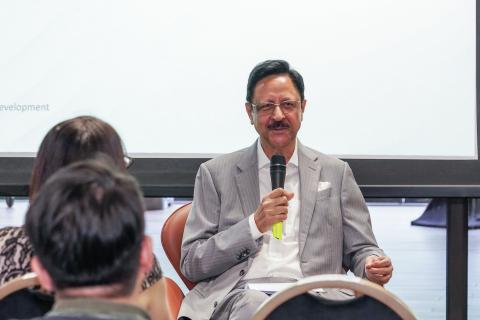
- Dr Shahzad Nasim, Group Executive Chairman of Meinhardt Group; and
- Kenneth Loo, Executive Director and COO, Straits Construction Singapore Pte Ltd.





1. From cost optimisation to resilience by design
For years, cost efficiency has been a defining priority across the sector.
But in today’s environment, efficiency alone is no longer enough.
Global disruptions — from geopolitical tensions to supply chain shocks — have exposed the limitations of highly optimised systems. Leaders are increasingly shifting their focus towards resilience: diversifying supply chains, planning for volatility, and building buffers into project delivery models.
This marks a fundamental shift in mindset, because resilience is no longer a contingency plan. It is a core design principle.
2. Talent is a transformation challenge and no longer a pipeline issue
While manpower constraints remain one of the most pressing challenges for the sector, the issue runs deeper than numbers.
The sector is facing:
- An ageing workforce
- Limited inflow of younger professionals
- Growing demand for higher-skilled, tech-enabled roles
At the same time, the nature of work is evolving rapidly. With the rise of automation, AI, and advanced construction methods, the sector requires talent that is not only technically competent, but also adaptable and future-ready.
This reframes the challenge entirely.
It is no longer about filling roles. It is about reshaping the workforce for the future of the sector — and repositioning the Built Environment as a sector of choice.
3. Technology adoption with integration is the real test
Technology is no longer on the horizon. It is already reshaping the sector.
From AI-enabled design and cost optimisation to automation across construction and operations, digital capabilities are becoming embedded across the value chain.
Yet, adoption remains uneven.
The real challenge for leaders is not whether to invest in technology, but how to integrate it meaningfully and strategically. That means:
- Aligning technology investments with business priorities
- Ensuring workforce readiness alongside adoption
- Avoiding fragmented implementation across projects and organisations
Technology, in this context, is not a standalone initiative. It is a system-wide transformation lever.
4. Balancing short-term vs long-term trade-offs
Leaders in the sector are under constant pressure to deliver in the present. From managing costs, timelines, to operational constraints.
But at the same time, they are expected to invest in long-term priorities such as sustainability, decarbonisation, and capability building.
Traditionally, these have been viewed as competing priorities.
But in the Built Environment sector, where decisions made today are shaping outcomes over decades, this distinction does not hold.
Because long-term considerations are already embedded in present-day decisions.
The implication? Short-term execution and long-term transformation must be pursued in parallel, not in sequence. Leaders need to make pragmatic, calibrated trade-offs while ensuring near-term decisions do not undermine future competitiveness.

5. Collaboration is the sector's most strategic advantage
The Built Environment sector is inherently interconnected.
Every project depends on coordination across multiple stakeholders, from policymakers and regulators to developers, contractors, consultants, and academia.
This makes collaboration not just beneficial, but essential. A consistent message from the plenary was— No single organisation can drive transformation alone.
In a complex and rapidly evolving environment, collaboration is not just a way of working. It is a competitive advantage. Progress will depend on:
- Stronger public-private alignment
- Cross-sector partnerships
- Shared commitment to capability building