

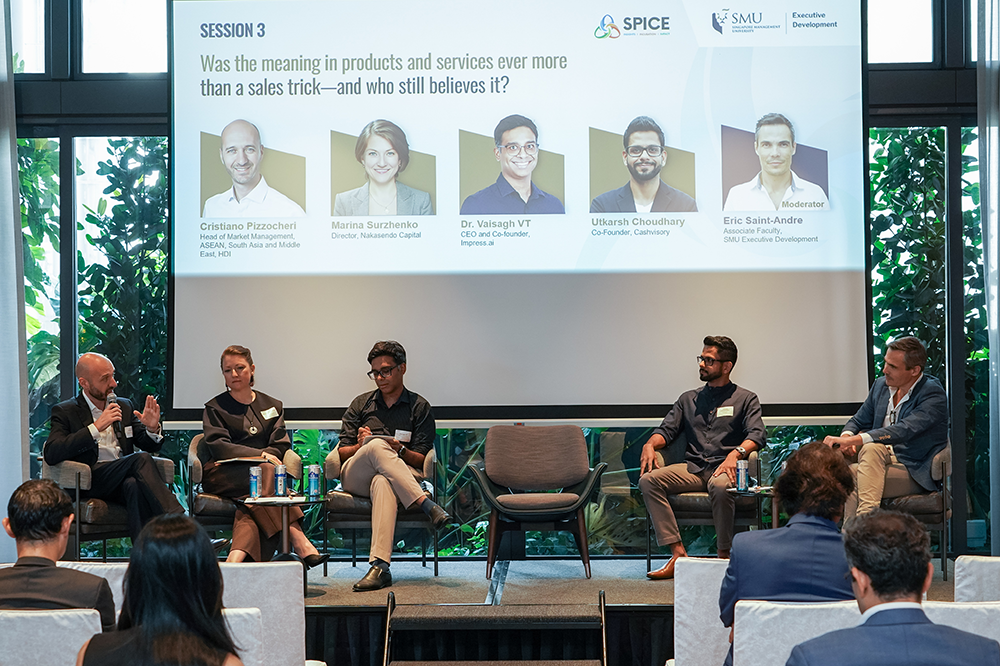
The following article is a brief recap of the discussion that transpired during the SPICE Insights Hub Conference on 26 February.
In recent years, many organisations have embraced the language of corporate purpose.
Mission statements increasingly highlight commitments to sustainability, societal impact, and stakeholder value.
Yet scepticism remains.
Is purpose truly shaping organisational behaviour? Or simply enhancing corporate reputation?
This question sparked lively debate during one of the SPICE panels with Eric Saint-Andre, Utkarsh Choudhary, Dr. Vaisagh VT, Marina Surzhenko and Cristiano Pizzocheri
Transparency makes purpose harder to fake
In previous decades, organisations could maintain a gap between what they said and what they did.
Today, digital transparency has fundamentally changed this dynamic.
Employees, customers, and investors now observe corporate behaviour through multiple channels, from social media to ESG disclosures.
As a result, inconsistencies between values and actions can quickly become visible.
In this environment, purpose cannot remain purely rhetorical.


Embedding purpose into organisational design
For purpose to influence behaviour, it must be embedded in the structure of the organisation itself.
This includes alignment across:
- governance mechanisms
- incentive systems
- operational processes
- internal communication
Without such alignment, purpose remains little more than a branding exercise.
Many organisations are discovering that purpose is not defined once in a mission statement.
Instead, it must be reinforced through daily practices and leadership decisions.
Small routines such as values-based reflection or purpose-driven decision frameworks can gradually embed purpose into organisational culture.



The challenge of scaling purpose
Maintaining purpose becomes more difficult as organisations grow.
Operational complexity, competitive pressures, and global expansion can dilute original values.
Leadership therefore plays a crucial role in ensuring that purpose remains a guiding principle rather than a symbolic statement.
Ultimately, purpose is powerful only when it becomes something organisations practice regularly, not something they publish occasionally.